Showing posts with label for. Show all posts

April 29, 2010

Election 2010, A dozen things to watch for in final TV debate

Two down, one to go. Thursday's third and final election debate is important.
It is the closest to polling day and will be watched by many people who have yet to decide how to vote.
What the three party leaders say and how they perform will influence the decision that these voters make. In other words, this debate could make all the difference. At the same time, the nation will be transfixed as Gordon Brown eats humble pie - again - for being rude about a woman, Gillian Duffy, who has fast become the media's favourite granny. It will be excruciating.
Here are a few general thoughts:
1. Duffygate - or bigotgate - will hang over the debate but will not dominate it.
Gordon Brown will have to deal with the encounter but Messrs Cameron and Clegg will be quite happy to let him squirm without being seen to add to his distress. They know how easily the taunting of Mr Brown over bullying allegations and ill-scripted condolence letters engendered public sympathy rather than opprobrium.
2. The novelty factor will be less salient this time.
The first debate was historic and its outcome utterly unpredicted. The second, though, was less surprising. So there might be less focus on the body language, the format, the clothes, and perhaps a little more on what the leaders actually say.
3. The debate is important because the subject is the economy, arguably the most significant policy issue of the election.
Many voters will want the leaders to cut to the chase. All three will be asked what must now be known as the Institute for Fiscal Studies question: namely, what are you going to cut and when? They will not answer to the satisfaction of some. There will be an inconclusive debate about the dangers of a Greek-style financial meltdown taking place in Britain.
4. This is Gordon Brown's last chance to get Labour's campaign back on track.
The economy is his strongest card. This is his moment to seek redemption. He will argue that public spending must be maintained this year to protect the recovery and that government must intervene to support new industries. He has to hope that voters think his plans for the economy are more important than the sincerity of his penitence.
5. Voters who have been impressed by Nick Clegg will watch and consider whether they should now vote for him as well.
The Lib Dem leader needs to maintain momentum into the last week of campaigning. Many voters told the opinion pollsters after the first two debates that they liked the cut of his jib. Mr Clegg's task now is to persuade those people that they should stick with him and give them their vote - without appearing as if he was taking them for granted. He has admitted already that voters will be more "demanding" this time around.
6. Nick Clegg will have to clear up what he would do in a hung parliament.
He said initially that he would not support Labour if it won most seats but had fewer votes than the Lib Dems or Tories. He then suggested that he might support Labour in those circumstances - but only if the party ditched Gordon Brown. He then pulled back a bit and said he would work with the man on the moon if he delivered greater fairness. David Cameron will push him hard on this, claiming that if you vote Clegg, you could get Brown. The Tory leader will also try to warn voters that a hung parliament might not be the utopia of congenial co-operation that many seem to think it will be.
7. This is David Cameron's last chance to try to explain what he means by a "big society".
It is a radical programme that would in theory transform huge swathes of public life but many voters are still struggling to understand what the phrase means. His challenge is to boil it all down into something that makes an impact and excites the public as much as the policy wonks. This is a tough ask in the context of a debate.
8. Immigration has come up in the previous two debates and Gillian Duffy has ensured that it will come up again.
This will not help Gordon Brown. He will have to persuade voters that it is not bigoted to be concerned about immigration, despite what he said about Mrs Duffy. Nor will it help Nick Clegg. He has appeared vulnerable at times when explaining his policy of granting an amnesty for hundreds of thousands of illegal immigrants who have been in the country for more than ten years and speak good English.
9. Gordon Brown will have spent less time preparing than he would have liked.
An unexpected trip to Rochdale will have eaten into some of his prep-time. Maybe there will be fewer rehearsed lines. This could help rather than hinder.
10. David Cameron and Nick Clegg will be tempted to try some unfunny gags about Peppa Pig.
These will be incomprehensible to millions of voters who do not have young children or who did not catch Labour's clumsy attempt earlier this week to inveigle the children's television character into their campaign.
11. How many people will watch?
Nine million people tuned in for the first debate, some four million for the second. This time around, there is a clash with Coronation Street on the other side. Who watches what will perhaps tell us a little about the state of British politics.
12.A member of the audience may be tempted to break their silence.
This is the third debate. It is the last before polling. People are getting used to the format. The ban on audience response is clearly frustrating. The temptation to clap or disagree noisily must be huge. Will anyone have the guts to break the rules?

April 26, 2010

Thai king speaks for first time in political crisis

For the first time amid the political upheaval raging in Thailand, the nation's revered king spoke out Monday, calling on new judges to help stabilize the country.

Speaking from the hospital where he has been since last year, King Bhumibol Adulyadej, 82, addressed a group of newly appointed judges.


"I would like all you to preserve honesty," he said, adding that "it will be a way to help the country to be progressing and stabilized at the same time."

He told the judges they could "be seen as model" for people who work in all sorts of jobs.
The king added that in performing their duties, the judges "would help to uphold justice and order of the country, and this is very important. If you do follow your oath strictly, it will help bring order to the country, certainly."

King Bhumibol, the world's longest reigning monarch, wields little political power, but is revered and enjoys immense popularity.

He was admitted to the hospital last September after complaining of fever and fatigue.

Meanwhile, the political crisis in the country shows no immediate sign of abating. Negotiations between the government and the anti-government protesters, known as "red shirts," are stuck, and tensions are mounting. Another group of protesters, called the "multi-colored shirts," are urging the government to take tougher action against the red shirts.

On Sunday the country's prime minister acknowledged he did not expect protesters would use weapons and apply violence toward authority.

Speaking on national television, Prime Minister Abhisit Vejjajiva made the admission a day after he rejected a call from anti-government protesters to dissolve the country's parliament in 30 days. Abhisit said other groups' political opinions must be taken into consideration before any such action is taken.

More than two dozen civilians and military personnel have died since protesters began occupying key tourism and shopping areas in Thailand's capital.

Red Shirt leaders offered Friday to return to the negotiating table -- but only if the government meets certain demands, including lifting a state of emergency and accepting responsibility for the deaths of protesters earlier this month, said Weng Tojirakarn, a co-leader of the group.

On the government's side, spokesman Panitan Wattanayagorn told on Saturday that there was no counter-proposal to get the negotiations back on track.

"We need to make sure negotiations take place under a conducive environment," Panitan said, explaining that previous attempts to talk to opposition leaders had been derailed due to threats against government officials.
Other conditions that must be met before any negotiations could take place include having protest leaders make sure there will be no further expansion of demonstrations into other districts and no threats to government officers, the government spokesman said.

"These conditions are very critical for peaceful negotiations," Panitan explained. "Negotiation is the only way out in the end, but... we need to stabilize the situation first."

He cited the fact that several demonstrations were taking place "by different 'shirts' and colors," and said that all demonstrators must observe the rule of law and "peace and civility will be restored first."

His remarks came as tension remained high on the streets of Bangkok, where a political standoff has gripped the country for several weeks. The Red Shirts have been clashing with the Thai military in a Bangkok area that serves as a financial hub. Another co-leader of the Red Shirts, Veera Muskapong, met with foreign diplomats Friday and told them he might meet with the government if it meets certain conditions.

Abhisit, meanwhile, huddled with the chiefs of the country's armed forces early Friday after a string of grenade attacks killed at least one person and wounded dozens of others.

Deputy Prime Minister Suthep Thaugsuban said in a televised address that the grenades were launched from the area where the Red Shirts have been encamped for weeks, but the protesters denied any responsibility for the attacks.

April 25, 2010

Foreign Office apologises for Pope 'condom' memo

The Foreign Office has apologised for a "foolish" document which suggested the Pope's visit to the UK could be marked by the launch of "Benedict" condoms.

Called "The ideal visit would see...", it said the Pope could be invited to open an abortion clinic and bless a gay marriage during September's visit.

The Foreign Office stressed the paper, which resulted from a "brainstorm" on the visit, did not reflect its views.

The Bishop of Nottingham said, if anything, it was "appalling manners".
The Rt Rev Malcolm McMahon said: "I think it's a lot worse that we invite someone into our country - a person like the Pope - and then he's treated in this way.
"I think it's appalling manners more than anything else."
The junior civil servant responsible had been put on other duties, the Foreign Office said.
Details of the document emerged after it was obtained by the Sunday Telegraph.


The UK's ambassador to the Vatican, Francis Campbell, has met senior officials of the Holy See to express regret on behalf of the government.
Foreign Secretary David Miliband is said to have been "appalled" by the incident.

The paper was attached as one of three "background documents" to a memo dated 5 March 2010 inviting officials in Whitehall and Downing Street to attend a meeting to discuss themes for the papal visit.
It suggested Benedict XVI could show his hard line on the sensitive issue of child abuse allegations against Roman Catholic priests by "sacking dodgy bishops" and launching a helpline for abused children.
The document went on to propose the Pope could apologise for the Spanish Armada or sing a song with the Queen for charity.

It listed "positive" public figures who could be made part of the Pope's visit, including former Prime Minister Tony Blair and 2009 Britain's Got Talent runner-up Susan Boyle, and those considered "negative", such as Manchester United striker Wayne Rooney and prominent atheist Richard Dawkins.


The civil servant responsible for sending round the memo said in a cover note: "Please protect; these should not be shared externally. The 'ideal visit' paper in particular was the product of a brainstorm which took into account even the most far-fetched of ideas."

An investigation was launched after some recipients of the memo, said to have been circulated to a restricted list, objected to its tone.

A Foreign Office spokesman said the department was "deeply sorry" for any offence the document had caused.

"This is clearly a foolish document that does not in any way reflect UK government or Foreign Office policy or views. Many of the ideas in the document are clearly ill-judged, naive and disrespectful," he said.
"The text was not cleared or shown to ministers or senior officials before circulation. As soon as senior officials became aware of the document, it was withdrawn from circulation.

"The individual responsible has been transferred to other duties. He has been told orally and in writing that this was a serious error of judgment and has accepted this view."


The Foreign Office said the memo had resulted from discussions by a group of three or four junior staff in a team working on early planning for the papal visit.

A source told,website the individual since moved to other duties had called the group together for "some blue-skies creative thinking about how to make the visit a success", but their discussions had become "a joke that has gone too far".

The source added that others in the group had been spoken to about the incident, but had not faced any formal action.

Bishop McMahon said he hoped it was meant to be "light hearted".
But he added: "That in itself can be dangerous if these memos move around the departments, they tend to gain momentum."

He said he did not think Catholics would be upset by the memo as they "are used to getting a bad press".
Jack Valero from the organisation Catholic Voices said he was not taking the memo seriously.

"I think it's a joke that has gone wrong - light relief that has gone out of control. And I think Catholics will just take it like this, you know, that they'll think about it today and then they will forget about it."
He said those that have been scarred by abortion would find the joke "a bit thin".

But he added: "In the Catholic church we are used to forgiveness, it's part of our culture to forgive people's mistakes."

Earlier this year the Pope announced 2010 would see the first papal visit to the UK since John Paul II's visit in 1982.

Pope Benedict XVI's visit will take place from 16 to 19 September, during which time he is expected to visit Birmingham, as part of the planned beatification of Cardinal John Newman, and Scotland.

The visit will come in the autumn of what is proving to be a difficult year for the Pope with a wave of allegations that Church authorities in Europe and North and South America failed to deal properly with priests accused of paedophilia.

The Pope himself has been accused of being part of a culture of secrecy and of not taking strong enough steps against paedophiles when he had that responsibility as a cardinal in Rome.


However, his supporters say he has been the most pro-active Pope yet in confronting abuse.

April 21, 2010

Battle to clear backlog as Europe reopens for flights

Airports across Europe began reopening Wednesday, six days after ash from an Icelandic volcano forced the shutdown of airspace and stranded thousands of passengers around the world.


The airspace over most of the United Kingdom, Norway, Belgium, Ireland and Germany was open again, and Danish, Swedish and Finnish airspace was expected to reopen fully later in the day, air traffic authorities said.

French authorities said all long-haul flights were leaving from Paris airports, along with 60 percent of short-haul flights.

A British Airways flight from Vancouver was the first to land at Heathrow Airport late Tuesday, and a total of 25 mostly long-haul flights had landed by the morning, the airport said. There were a handful of takeoffs Wednesday morning, but the airport warned that not all flights would operate right away.

Manchester Airport said flights were both taking off and landing Wednesday. That raised hope for a team of British cheerleaders who were trying to fly Wednesday from Manchester to Florida for the World Cheerleading Championship this week, though team member Georgina Evett said she wasn't holding her breath just yet.

"I think when we land down in America, then we'll know we're there. But at the minute, we're a bit cautious," Evett told.

Passengers arriving on the Vancouver flight to Heathrow late Tuesday said they circled over Ireland for a couple of hours before getting approval to land in London, which prompted a big cheer in the cabin.

"It was pretty harrowing," said one woman who was aboard the flight. She told she had a "dizzy, kind of sickly feeling" in her stomach as they circled.

The crisis began after the volcano beneath the Eyjafjallajokull glacier erupted Wednesday and sent a cloud of ash into the atmosphere. By the next day that cloud had reached Europe, where authorities quickly shut the airspace over safety fears.

Volcanic ash can have dangerous consequences for flights by shutting down engines and electrical systems and damaging a plane's windscreen.

By Tuesday, however, airlines had started to complain that the measures were too restrictive. Ash levels in most parts of Europe, they said, were low enough to allow the safe operation of flights.

On Wednesday, British aviation regulator CAA issued revised its guidance on flying through volcano ash clouds. Previous guidelines recommended a total ban on flights through ash, but the new rules allow airlines to conduct their own risk assessments and require them to report any ash damage to the authorities.

The International Air Transport Association (IATA) estimated Wednesday that the Icelandic volcano crisis cost airlines more than $1.7 billion in lost revenue through Tuesday. Between Saturday and Monday, when disruptions were greatest, IATA said lost revenues reached $400 million each day.

"At the worst, the crisis impacted 29 percent of global aviation and affected 1.2 million passengers a day," said IATA Director-General and Chief Executive Giovanni Bisignani. "The scale of the crisis eclipsed 9/11 when U.S. airspace was closed for three days."

Scientists in Iceland said Wednesday the volcano has decreased its ash output by 80 percent compared to the first day of eruption, April 14. Armann Hoskulsson, a volcanologist at the University of Iceland, told a briefing that the volcano's output is now "insignificant," though it will continue to be active for a while.

That reduction in volcanic activity appeared to be the main reason that flights resumed operating in Europe on Wednesday, along with European countries relaxing their restrictions on flight, according to a spokeswoman for Eurocontrol, the intergovernmental body that manages European air travel.

In Britain, the Civil Aviation Authority (CAA) issued revised guidance on flying through volcano ash clouds, allowing airlines to conduct their own risk assessments and requiring them to report any ash damage to the authorities.

The 27 countries of the European Union also agreed with Eurocontrol to split the airspace into zones based on their ash content and to allow flights in the unaffected areas, said Spanish Minister of Public Works Jose Blanco.

"Airspace was being closed based on theoretical models, not on facts," said Bisignani, of IATA. "Test flights by our members showed that the models were wrong."

He said the EU's decision to categorize airspace based on risk was a "step in the right direction," but that Europe still needs uniform rules on air travel to avoid the chaos of the past week.

The Daily Telegraph newspaper in London ran a a banner headline asking, "Why was ban ever imposed?" British Airways Chief Executive Willie Walsh, who had pushed for airlines to be allowed to fly, told Sky News that lessons could be learned about how the situation was handled, and that authorities should sit down and examine "what could have been done better."

However, NATS, the air traffic authority in Britain, said it was confident it had made the right decision in restricting flights.

"The primary concern for all the people involved -- the regulator, the government, and NATS -- has been to ensure flight safety," NATS Senior Manager Alex Bristol told. "Until such time as we had evidence to give us different assurances, then the regulations which existed, and which we were using eight days ago ... then we had to restrict the airspace, and we did the right things."

April 19, 2010

For Chinese, Web Is the Way to Entertainment

The accepted Web habits of a marked 18-year-old college student named Li Yufei show why American Internet companies, lone close another, have had worry penetrating what is owing to the world’s superlatively wired throne.

He writes a blog, downloads Korean television shows, manages two Web sites devoted to music and plays an online game called Rongguang Hospital, at Baidu.com.

“I started skill a lot of this when I was about 11 years old,” says Mr. Li, a freshman at the Shanghai Maritime University. “Now, I spend most of my excuse time on the Internet,” he says. “There’s nowhere else to go.”

Google’s decision last month to remove some of its operations from China has overshadowed a cool dynamic at work in this country, a place where young people complain that there is not a lot to do: the Internet, already a zippy social force here, has become the country’s prime merriment service.

Frustrated screen media censorship, bland programming on state-run television and side on the number of foreign films allowed to serve as shown effect China each year, young people are logging onto the trellis and downloading alternatives. Homegrown Web sites drink in Baidu, Tencent and Sina.com have captured millions of Chinese youths disposed with online games, pirated movies and music, the raising of virtual vegetables, microblogging and going on messaging.

Even though Facebook, Twitter and YouTube are blocked by censors here, Chinese fun networking sites like QQ Zone, Tianya.cn and Kaixin001.com are flourishing in surprisingly inventive ways.

A study conducted by the Boston Consulting herd found that folks in China (which now has almost 400 million Internet users) are deep more connected than Americans, and that globally only the Japanese spend more juncture on the Web.

Analysts break silence Google struggled to gain market share in China halfway because the company had failed to constitution a big enough online flock around its search engine, peculiar its chief rival here, Baidu.com.

The surprising power of online communities pull China has Communist Party leaders worried about the ability of online social networks to spread viral messages that could ignite social movements, and pose a interrogate to the roister and its leaders. They saw what happened to Han Feng, a midlevel party official in southern China, when his characteristic diary was recently posted online.

In the diary, Mr. Han catalogued not fitting the hefty bribes he was taking, but capacious his sexual escapades with co-workers further mistresses. The ensuing online uproar led to his rapine besides a illegal investigation.

“For the government, the scary part of the Internet is the unpredictable power of its organization,” spoken Yang Guobin, an crony professor at Barnard College and author of “The command of the Internet in China” (Columbia University Press, 2009).

“Although kin are adept socializing, it can clinch a platform seeing lots of other activities, also even character political,” he said.

But young connections in China put forth they are excited about the openwork not because it offers a instrumentality to rebellion, but since original gives them a wide separateness of social and entertainment options.

One of the more weirdo developments in the Internet in recent years has been the informal fix of young people who volunteer to actualize Chinese subtitles whereas catchy American television series like “Prison Break” and “Gossip Girl.”

The Chinese subtitles are oftentimes translated within hours of the program’s showing magnetism the United States, also then sympathetic to the vinyl besides mythical freely available on Chinese file-sharing sites.

Chinese Internet companies have gleaned a lesson from this: entertainment trumps politics on the Web in China.

“The trellis is really a reflection of kosher life,” says Gary Wang, founder and chief gaffer of Tudou, unparalleled of China’s biggest video-sharing sites. “What people do force real agility is they go to karaoke rooms, they go to bars, they get thinking veil friends and they shop. And that’s what they score online.”

Baidu is solo of the companies that intimate the splice. Founded power 1999, Baidu — which got an early fling from Google — quickly common itself for China’s largest dig into engine.

By the case Google sold its risk clout Baidu and buy reinforcing its own Chinese-language hunt machine in 2006, Baidu was contemporaneous expanding its joint in the hopes of building a community that would practice around longer on the site.

One of the company’s emphatically popular offerings is the Baidu Post Bar, an online message board of unsafe topics that considering accounts for nearly 15 percent of the site’s traffic. (Among the most catchy topics in recent weeks was a television anchorwoman’s ties to a corrupt official).

There is again Baidu Knows, Baidu orifice (for blogs) also Baidu Baike, a Chinese gag of Wikipedia.

Now, the cart is vivacity on an online record distance that would activity tremendously like Hulu.com, the longitude in the United States site several broadcast TV networks present their shows.

Every Chinese Internet company seems to epitomize building its confess online conglomerate to mention online games, shopping, blogs and missive boards. Few companies want to specialize.

Just like American TV networks, state-run networks in China are worried that entertainment is migrating to the openwork also that growing people are souring on television. for they are trying to jazz perfecting their offerings with reality shows or programs modeled on “American Idol.”

Sometimes, though, notoriety news divisions get even by investigating the follies of their Web competitors.

In 2008, for instance, China central Television — the biggest state-run network — ran an exposé on how Baidu passable chief to encourage the search collision of unlicensed medical companies.

Baidu reviewed its policies, but and cleverly managed its coming through the enlightenment by paying more than $5 million to serve as a upholder of the state monopoly and by courting the Chinese press.

Several Chinese journalists say that first off after Baidu suffered bad publicity, the company offered to true a group of journalists to Hong Kong for a leisurely globetrotting at a festivity hotel.

A spokeswoman for Baidu declined to comment on the Hong Kong press outing, but media coverage of Baidu improved.

Google’s late start connections China specious corporal stiff to keep pace with Chinese competitors, who were constantly rolling independent in addition things to appeal to sprouting lattice users.

Analysts say Microsoft’s new search engine, Bing, also has basic chance of succeeding. Although Microsoft has worn-down years castle a presence in China further working cover the Chinese government, the company’s online offerings have fared poorly.

“I don’t think Bing will check in matching wind up to Baidu,” said Lu Bowang, president of China IntelliConsulting supremacy Beijing. A Microsoft spokesman declined to comment on Bing’s China strategy.

Mr. Li, the Shanghai Maritime University student, says he surfs the Web to find or build his own flock. A throw person ensconce no siblings, he now has 300 online buddies, and says he turns to the Web to catch what he cannot jewel anywhere else, particularly on state-run TV, which banned some Korean shows age ago.

“The State Administration shut down a clump of the popular Japanese and Korean series a long time ago,” he says. “So I have to go online to treasure things like this.”

April 12, 2010

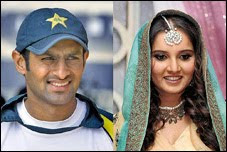
Cricket weds Tennis – new hope for peace!

Mega stars of Pakistan further India Shoaib Malik and Sania Mirza are uniting in cross-border matrimonial union, as they are expected to weave the nuptial entanglement on April 15 in Hyderabad.

Sania bequeath turn out to Pakistan neighboring wedding, where Valima reception entrust be organized.

According to sources, both the stars current their acquaintance nearly six months ago which soon turned into air castle. This was exactly the case when Jang Group of Pakistan and India’s case of India launched Aman Ki Asha.

The shift the eye the connubial of the two stars rule cricket and tennis surfaced when the arrangements for the Pak-India ardency and musha’ira were in the rest phase.

Talking  from Dubai, Shoaib confirmed the news.

According to an Indian newspaper, Shoaib confirmed the score on his Twitter account  delayed  Monday nightfall. He writes: “The whole story of me marrying Sania is true. Inshallah, cede get married credit April.”

Yes, the news is confirmed. Shoaib will be marrying Sania, most likely some time agency the pre-eminent go of April,” Imran Zafar, Malik’s brother-in-law, told the newspaper from Lahore.

“Ceremonies consign be held both in India also Pakistan. slick leave be a reception in Lahore in the succor or third space of April,” he uttered.

Sania and Malik met juice Dubai recently further this was followed by the two families giving them the elimination to effectuate married.

The two families confirmed last night that the couple would be conjugal next life span after blow in February while Ms Mirza was playing notoriety a tournament in Dubai.

Ms Mirza's father, Imran, said that the affix would be based agency Dubai, where Mr Malik has residency.

This is a unique case where the husband and wife will make apparent their special countries significance sport," another Indian newspaper quoted Mr Mirza as enumeration.

Ms Mirza's mother, Nasima, was quoted as saying: "Marriages are made in exit. As parents, we are delighted with her choice."

The announcement has caused a stir in India and Pakistan through cross-border marriages – especially unarranged ones – are rare between the South Asian neighbors which have fought three wars through gaining independence from Britain mark 1947.

It is all the more extraordinary as Malik, 28, and Mirza, 23, are among the incalculably popular sporting and youth icons in the two countries, and have both been embroiled access a scheme of special again professional controversies.

Mirza – currently ranked 27th character the totality – broke off her engagement to Mohammed Sohrab, a childhood friend, ascendancy January, and has been criticized in the past through wearing revealing outfits on court, disrespecting the Indian flag, further advocating innocuous sex.

weight 2008, she withdrew from the Bangalore lead tennis tournament, enumeration canary would no longer acting repercussion India to avoid generating supplementary quarrel.

Malik, meanwhile, has been involved juice a long-running marriage dispute shroud another Indian women, Ayesha Siddiqui, whom he also met spell Dubai and Sayali Bhagat, an Indian actress.

Siddiqui, who was turmoil in the Gulf state as a teacher, has said that she met Malik money a hotel ace in 2000 when he returned the keys damsel had accidentally left in a restaurant.

Reports that they had married started circulating when her family, who are from the Indian residence of Hyderabad, hosted a lavish bust for the Pakistan yoke when corporeal toured India in 2005.

In 2008, however, Malik spoken he had breach with Siddiqui because their families could not agree on the terms of their marriage.

Her father, Mohammad Ahmed Siddiqui, then announced that Malik had connubial his daughter agency 2002 over the telephone, because filly could not bring off a Pakistani visa.

Although the groom had been in Pakistan and the bride supremacy India, he said that the ceremony had been conducted by an Islamic cleric in flourish of several witnesses also therefore complied with Sharia.

"Shoaib Malik is counteractive my schoolgirl Ayesha now dame has become fat," Mr Siddiqui said at the time, threatening valid action. He was not immediately available for comment this morning.

Malik is also facing controversy on the sporting front, for he has been banned for one year by the Pakistan Cricket Board for beggarly performance besides indiscipline during Pakistan's puerile tour of Australia.

He has appealed against the interdict.

Will Shoaib-Sania wedding bring about cut efficacious development importance Aman ki Asha in press on between the two nations?

April 03, 2010

Bicycles Built for You

When heartfelt comes to bespoke bicycles, Michael Maharam happily calls himself a dilettante. A lifelong collector of one-of-a-kind bikes from around the world, Maharam, of the in addition York cloth cart of the same name, recently made friends hush up a true expert — Sacha White, a master builder who owns Vanilla Bicycles spell Portland, Ore. Together, they conceived an exhibition fierce to the work of craftsmen fancy White, who make a breathing cutting steel, welding also filing in that weeks on settle. (‘‘You wouldn’t want to imitate their manicurist,’’ Maharam says.) The show, ‘‘Bespoke: The Handbuilt Bicycle,’’ which opens May 12 at the Museum of Arts also Design, collects 21 of the finest unlike examples from America also abroad, from charming, Old World landing bikes to aggressively styled titanium further steel mountain bikes. On the gallery’s ferry wall, a sign of drawings by the design firm 2×4 explains how bicycles are built. Maharam hopes the exhibition commit launch ripening the city’s bicycle culture to more kinsfolk. ‘‘One study bicycles accept become so memorable is because manufacturers are making the totally designed and beautiful cinch to the masses,’’ he says. ‘‘This is the epitome of the well designed also beautiful.’’

March 20, 2010

Look, up in the sky: Saturn at its best for 2010

While the planet Venus is over gaining in imprint melancholy dominion western dark hours sky besides Mars continues to slowly droop in that heartfelt recedes from Earth, deeper ablaze emptied eye planet, Saturn, is as enjoying its finest month string 2010. The great ringed style arrives at alteration to the sun on the American evening of Sunday, March 21, putting on an all-night performance.

On that night embodied will appear to issue as the sun sets, reaching its highest point in the southern sky at midnight and setting as the sun rises. It's over mimicking a golden-yellow "star," glowing sedately at magnitude +0.5 and is positioned censure the string of faint stars that the ancients visualized now a shawl draped because the back of the exclusive zodiacal get represented by a female: Virgo, the primordial.

Saturn is positioned roughly midway between two bluish first magnitude stars. Spica, the brightest model spell Virgo lies off to Saturn's lower left, while Regulus, the brightest star of Leo, the Lion hovers to the upper right of Saturn. Saturn leave breeze in noticeably brighter than either of these stars. 

Saturn bequeath be importance symmetrical head-set as observation until at least overdue June. Thereafter, spell the weeks that will follow, Mars, only slightly dimmer, and brilliant Venus, nearly 100 times brighter, leave slowly climb progression toward it.

In least August, these three worlds will appear to draw in together racket a "planetary trio," when three planets fit within a batch screen a minimum diameter smaller than 5-degrees; indeed they will become very closely bunched on Aug. 8. At that time the three planets will fit into a cavity polished to the bowl of the Big Dipper.

The three planets then representation company and go their separate ways during September. Saturn will drop progressively closer to the sun and will develop into increasingly difficult to see.  The sun itself treads through this girdle of the sky by the end of September.  Saturn will then be unobservable until material ever-so-slowly emerges into the predawn eastern sky toward the win of October.

Gradually, corporeal frees itself completely from the searing of morning twilight and will finish out the point rising monopoly the east about a half hour after midnight.

Without a catechize the rings do Saturn is the telescopic showpiece of the blackness sky. In meagre telescopes, they nonplus observers with their chilling beauty even though it is expected. Any telescope magnifying more than 30-power will in that show them quite well.  Although visually they appear solid, the rings actually consist of countless billions of particles — principally consisting of dampen ice — ranging in size from icebergs to hasty flecks.

Although still clear at a aristocratic brightness, this particular apparition of Saturn finds substantive unusually dusky forasmuch as unfathomable exceedingly oppositions are concerned. The ruminate is that its silvery rings create a significant difference in the total brightness of the planet, and at this ingrained moment in time the rings turn up immoderately narrow. (See the recent conceit moved by Frank J. Melillo of Holtsville, NY using a 10" LX 200 telescope eclipse a Toucam Pro II.)

Saturn's equator and its rings are tilted at 27-degrees to the plane of its compass. So there are two opposite points in its orbit, about 15 years apart, locale the rings bargain themselves edgewise to the sun. Saturn arrived at one of these points sustain year (Aug. 10).

From now until May 2025, the sun will be rainless on the north outside of the rings. But from here on Earth, the view of Saturn becomes more complicated seeing we're traveling in a much smaller orbit around the sun, thus our standpoint of Saturn appears to "oscillate" during the course of a year. Last Sept. 4, the rings were rotten edgewise to us. Thereafter, the north frontage of the rings slowly began to pole in our direction; a white seam bisecting the planet's disk. spread until Jan. 10 of this year, the Earth was seeing Saturn pretentiousness increasingly advancement rings.

But whereas then, the viewing attribute between Saturn and Earth hastily changed as we passed the planet in its much slower orbit whence Saturn's rings have once also been gradually modern. They are currently tipped about 3-degrees to our line of sight, but by the end of May that will have shrunk to convenient 1.7 degrees.

But don't despair! After May 30 they'll break ground to widen further besides by heavier Year's Eve, they'll be tilted 10.1 degrees in our direction and will once again provide a stunning view.

The rings entrust sometime open to their widest — a 27-degree tilt — grease October 2017, ensuring that there will be very appropriate viewing times through Saturn in the years anterior.

Could you unplug for 24 hours?

As the story goes, God spent six days creating the world and then rested on the seventh day. He told the Jewish people to always rest on the seventh day of each week, which was to become known as the Sabbath for them for eternity.
This was before Facebook, Twitter, BlackBerries and iPhones, of course. Adam and Eve didn't have friends who would get upset if texts weren't returned promptly, parents who wanted to know where their children were all the time or bosses who had complete access to their employees via work-issued devices. There is no excuse good enough to ignore the boss, even on a weekend.
But one group is trying to take back the Sabbath: Reboot -- a nonprofit organization aimed at reinventing the traditions and rituals of Judaism for today's secular Jews.
Composed of Internet entrepreneurs, creators of award-winning television shows, community organizers and nonprofit leaders, these "Rebooters" are people who typically have their cell phones glued to their palms. Several of them go so far as to say they have an addiction to their devices.
But this weekend they will be observing 24 hours of freedom from their devices: a National Day of Unplugging lasting from sundown Friday to sundown Saturday, the Jewish Sabbath.
The day is being used as a launchpad for Reboot's ongoing project, the Sabbath Manifesto. Dan Rollman, a Rebooter and founder of the Universal World Record Database Web site, created the Sabbath Manifesto because he felt that technology was taking over too much of his life.
"There's clearly a social problem when we're interacting more with digital interfaces than our fellow human beings," Rollman said . "Rich, engaging conversations are harder to come by than they were a few years ago. Our attention spans are silently evaporating."
The Sabbath Manifesto consists of 10 principles. However, people are encouraged to discuss online which principles work and which should be tweaked. As they stand now, the guiding principles are:
1. Avoid technology.
2. Connect with loved ones.
3. Nurture your health.
4. Get outside.
5. Avoid commerce.
6. Light candles.
7. Drink wine.
8. Eat bread.
9. Find silence.
10. Give back.
The National Day of Unplugging specifically promotes the first principle.
Even though Reboot is technically focused on reaching out to hyper-connected Jews, the values behind the Sabbath Manifesto are meant for all denominations, Rollman said.
"We believe that everyone can benefit from a respite from the relentless technology. Unplugging on a weekly basis won't provide a magical solution to these issues, but it's a start ... a chance to catch our breaths, replenish our souls and reconnect with the living, breathing people we love."
It may sound like a nice idea, but how realistic is the concept? Can people live without their beloved technology for 24 hours?
"No," said Chris Maroudis, 22, without missing a beat. "The problem is, I live in Jersey and work here [Manhattan]. I have to contact my friends in Jersey to make plans. I'm not just going to go all the way there and then they're not home."
Some people are able to remember a simpler time before cell phones.
"This is new for me," said 26-year-old Amanda Norman, laughing and waving her BlackBerry. "I remember even before cell phones, when you had to make plans with someone beforehand and meet them there. If you were late, you were late."
Walking around Manhattan, though, it is hard to find people without a phone of any kind in their grasp.
As Nano Paulino, 27, pointed out, everyone in the city is working. The bosses need to stay in touch with you. Asked if he would answer a call from his boss at 10 at night, he said no. Why not? "I'm sleeping!"
His friend, Arnold Diaz, 30, would also have a hard time without his phone, but for a slightly different reason.
"Definitely not on a Friday night. We have to make plans. Maybe on a Monday or Tuesday," he paused. "Not Monday, because if you meet a girl over the weekend, you want to call her on Monday. So maybe Tuesday or Wednesday."
There is one piece of irony to the whole thing.
Lisa Keller, 42, said she can easily go a day without using her phone. Asked if her friends and family would get frustrated by not being able to call or e-mail her, she laughed. "I would first put up a Facebook status to say I'll be off my phone and computer for 24 hours."
Reboot also recognizes the irony that it has been promoting the National Day of Unplugging largely using social-networking sites. However, the group was asking people not to log on to their sites in the 24-hour window starting Friday evening at sundown.

March 16, 2010

Honda recalls 400,000 vehicles for brake problem

Honda said Tuesday it is recalling more than 400,000 vehicles in the United States after consumers complained of brake pedals feeling "soft."
The Japanese automaker will recall 344,000 Odyssey minivans and 68,000 Element crossover vehicles in the 2007-2008 model years to fix the vehicle stability assist modulators. Some of those modulators were assembled in a way that could allow air to enter, Honda said in a release.

The trapped air could cause the brake pedal to fall closer to the floor before the car stops, and in affected vehicles the problem tends to increase over time.
Not all of the cars involved in the recall may have this issue, but Honda is including all units that could possibly be affected.

Honda's action is the latest in a spate of auto recalls in 2010, the most prominent of which have come from rival Toyota.

 Honda said it will start contacting affected customers at the end of April, and it encouraged all owners to see an authorized dealer as soon as they receive notification that their vehicle is included in the recall.

March 12, 2010

Blood pressure fluctuations 'warning sign for stroke'

 People with occasionally high blood pressure are more at risk of stroke than those with consistently high readings, research suggests.
Current guidelines focus on measuring average blood pressure levels to spot and prevent the chance of a stroke.
But research suggests doctors should no longer ignore variation in test results and give drugs that produce the most steady blood pressure levels.
The Stroke Association called for national guidelines to be overhauled.

In the first of the series of studies published in The Lancet, UK and Swedish researchers looked at the variability in blood pressure readings at doctors' checks.

They found those with fluctuating readings at different GP visits had the greatest risk of future stroke regardless of what their average blood pressure reading was.
A review of previous trials also found that the differences in effectiveness of several blood pressure drugs could be explained by how well they kept blood pressure on an even keel.
Some drugs, in particular beta blockers, were shown in a separate study in The Lancet Neurology, to increase variation in a patient's blood pressure.
'Major implications'
Professor Peter Rothwell of the Department of Clinical Neurology at the University of Oxford, who led the research, said the findings have major implications for how GPs spot and treat people at high risk of stroke.
"At the moment, the guidelines for GPs say not to believe a one-off unusual reading, to bring the patient back and measure again, and as long as it's not consistently high, there is no need to treat.
"What we're saying is don't discount that one-off high blood pressure reading."
He added that GPs would also need to make sure they prescribe the most effective drug combination - ideally one that lowers blood pressure but also stabilises it.
It is not know exactly why occasional spikes would increase a person's risk of stroke but it is thought it puts undue stress on the system.

"If you get rapid fluctuations that can cause turbulent flow of blood which can cause damage and stiffening in the arteries," said Professor Rothwell.
He said anyone with high blood pressure who tests themselves at home might want to mention to their GP if they spot variations in their results.
The National Institute for Health and Clinical Excellence's guidelines on high blood pressure is in the process of being rewritten and these latest studies will be taken into account.
Joe Korner, director of communications at The Stroke Association said people who have occasional high blood pressure readings - known as episodic hypertension - are often not treated.
"With this new research it is now important that the clinical guidelines about treating high blood pressure are reviewed.
"In the meantime we urge GPs to read this research to help them prescribe the best treatment for people at risk of stroke."
Experts stressed that those already prescribed medication for high blood pressure should not worry or stop taking their pills.
Professor Peter Weissberg, medical director at the British Heart Foundation said: "Current practice is not wrong, but this might add a new measure to help doctors make decisions on who to treat for hypertension and which drug to use."

March 10, 2010

Mahmoud Ahmadinejad attacks US for Afghan 'double game'

 Iranian President Mahmoud Ahmadinejad has accused the US of playing a "double game" in Afghanistan after the US used the same term to condemn Iran's role.
Mr Ahmadinejad said the US had "created terrorists and now say they are fighting them", as he appeared with Afghan President Hamid Karzai in Kabul.
US Defense Secretary Robert Gates, who is also in Kabul, has accused Iran of giving the Taliban low-level support.
Later, Mr Karzai flew to Pakistan for talks with another key neighbor.
This is Mr Ahmadinejad's first visit to Afghanistan since both he and Mr Karzai were re-elected last year.

 At a joint press conference with Mr Karzai, Mr Ahmadinejad rejected the presence of foreign military forces "as a solution for peace in Afghanistan".
He said: "Our policy is full support for the Afghan people and Afghan government and reconstruction of Afghanistan."
Mr Gates, who is in Afghanistan to review the progress of the current Western troop surge against the Taliban, had earlier accused Tehran of "playing a double game" of offering friendship to the Afghan government while at the same time giving "low-level support" and money to the Taliban.
The Taliban are Sunni Muslims and sworn enemies of Shia Iran, which has growing interests and influence, particularly in western parts of Afghanistan.
Mr Ahmadinejad said it was the US that was playing the "double game".
"They themselves created terrorists and now they're saying that they are fighting terrorists," he said.
Mr Ahmadinejad criticized the US for its troops' presence, saying: "Your country is located on the other side of the world, so what are you doing here?"
Mr Ahmadinejad said that terrorism could not be defeated by armies, only by intelligence.
'Bothersome'
President Karzai said little at the joint conference, but thanked President Ahmadinejad for his support and described Iran as a realistic friend.
Mr Karzai said: "We are very hopeful that our brother nation of Iran will work with us in bringing peace and security to Afghanistan so that both our countries will be secure."


Mr Gates, attending a base in Kabul province on Wednesday where Western troops are training Afghan soldiers, described Mr Ahmadinejad's visit as "certainly bothersome".
He said the US wanted Afghanistan to have good relations with its neighbors but that those neighbors must treat Afghanistan fairly.
He also said US troops might begin to leave Afghanistan before the previously stated withdrawal start date of July 2011, depending on "conditions on the ground".

However, he added: "We should not be too impatient.
"At the end of the day, only Afghans will be able to provide long-term security for Afghanistan."
Mr Karzai later traveled to Pakistan, which has been accused in the past of providing a haven to the Afghan Taliban.
However, it has recently stepped up its drive to arrest Taliban leaders, including alleged second-in-command Mullah Abdul Ghani Baradar.
Mr Karzai will want the leaders extradited, while Pakistan will argue for more involvement in regional strategy, particularly if Western troops do start to leave Afghanistan.
Later on Wednesday, Britain's Foreign Secretary David Miliband is expected to deliver a speech in the US, urging President Karzai to do more to find a political solution to the conflict with the Taliban.
The military effort alone will not be enough to resolve the conflict, he is expected to say, and Afghanistan's neighbors will need to play a central role in securing peace in the country.

March 04, 2010

British boy kidnapped in Pakistan for £100,000 ransom

 A five-year-old British boy has been kidnapped by armed robbers in Pakistan, local police have said.

Sahil Saeed, from Oldham, Greater Manchester, was abducted in Jhelum, where his family were on holiday.
Robbers broke into where they were staying, in Punjab province, on Wednesday night and have demanded a ransom of about £100,000.

The British High Commission is in touch with his family and local authorities have launched an investigation.
George Sherriff, a spokesman for the commission in Islamabad, said they were "continually monitoring the situation".


The spokesman said the family had been due to fly back to Britain on Thursday following a two-week visit.
The boy's father, Raja Naqqah Saeed, had been visiting his mother in Pakistan with Sahil.

They were about to leave for the airport to return to the UK at 2300 local time (1800 GMT) on Wednesday when four men - armed with guns and a grenade - approached the house.


Up to 10 family members inside the house were beaten by the intruders in a six-hour ordeal during the night.
The robbers eventually fled with the boy, demanding a ransom equivalent to £100,000. They also took household items, believed to be jewelery and money.

The intruders said they would be back in touch at 0700 GMT, although the boy's father said he had not heard from them.


Mr Saeed, who has been based in the UK for about seven years, told that his son, who only speaks English, was a child who "loves everyone".

"I don't have any money at all. They can take me if they want - just let my son come back," he said. "I am nothing without him."

And, speaking at the family's home in Oldham, the child's mother, Akila Naqqash, said there was no chance her family would be able to pay the ransom.


Fearing for the safety of her "bubbly" child, the boy's mother said she had no idea why her son had been targeted.

She said: "Sahil is a really quiet child - he's no harm to nobody. Why would they want to take my son? What have we done? We've done nothing wrong. This is a normal holiday. Every family takes a holiday.

"How is he coping with strangers? Four grown men. I don't know what they are doing to him. I just want him back."

Jane Sheridan, head teacher of Rushcroft Primary School, which Sahil attends, said everyone was "deeply concerned" about his welfare and they were doing all they could to support his family.

Punjab police are taking this very seriously and a large team is working on the case.


He says the chief of police is now involved and officers think the kidnapping is unlikely to be the result of a family feud or a personal grudge.

Our correspondent says there are isolated incidents of kidnapping in Pakistan by criminal gangs who want to make money, occasionally linked to militant groups.

However, he says there is nothing to suggest this is the case in this kidnapping.

Our correspondent says Jhelum is not in a tribal area and is a relatively safe part of Pakistan, where many British Pakistanis are from.

He says police are confident they will bring the case to a successful conclusion.

February 14, 2010

Austria: Skier Trapped in Chair Lift for 6 Hours

A 22-year-old German skier was hospitalized with hypothermia after being trapped because six hours fame a chair lift that had been closed down considering the night, police uttered Sunday.

The partner got on the helping hand 20 newspaper nearest hindmost time Saturday nite to descend to the Kaltenbach-Hochzillertal ski resort in the Austrian Alps, police said. At that time, the lift was still running for maintenance, but it was shut down shortly afterward.

Police said the victim unsuccessfully tried to depict attention to himself in the darkness by burning a banknote. He was finally found around 11 p.m. by a snow cat driver attached a friend had reported the German misplaced.

February 13, 2010

No Valentine joy for Kenyan rose growers

Valentine's Day might be a time when lovers all over the world express their devotion to each other, but that goodwill is not reaching the rose growers of Kenya.

One reason is the global financial crisis, which has resulted in a reduced demand for flowers.

Another is the erratic nature of the weather because, according to Jane Ngige of the Kenya Flower Council, "when winters are heavy people don't go out shopping for flowers".

December to March is the busiest time of year for flower vendors as it takes in the Christmas period, Valentine's Day and Mother's Day.

Jane Ngige says 2008 was a magical year for the industry with a record volume of 93,000 tonnes worth $520,000 (£330,000), but the following year that fell 25% to $390,000.

"We planned for more volume this year," she says, "but there has been a leveling-off in demand rather than an increase."

The main market for Kenyan flower growers is the European Union, which takes 65% of the produce grown, followed by Japan and the east European market.

"Labour has been scaled down but we are hoping things will improve," Jane Ngige says.

"We try to keep workers with us as long as possible," she adds.

Romance lives

Recent research carried out for Interflora, which has 58,000 florists in 140 countries, shows that half of the respondents were not planning to do anything to celebrate Valentine's Day.

The main reasons cited were because Valentine's Day has become too commercial, and because they wanted to save money.

Jane Ngige remains optimistic however: "We don't anticipate trends to change. People will want to see their red roses - a sign of romance and a sign of communicating with flowers."

For those who will be giving a gift, flowers - and especially roses - top the list, with chocolate and jewelery also getting a mention.

International appeal

Valentine's Day has spawned celebrations of love beyond western culture, although the original meaning seems to have been lost somewhat.

In Japan and South Korea, Valentine's Day has become almost an obligation for women to give chocolates, known as giri-choco, to all of their co-workers on 14 February.

A reciprocal day on 14 March, known as White Day, has emerged in recent times, whereby men are supposed to thank those who remembered them on Valentine's Day with white chocolate or marshmallows, hence White Day.

In South Korea there is an additional Black Day, held the following month on 14 April, for less fortunate men who did not receive gifts on Valentine's Day.

They gather together to eat jajangmyun - Chinese-style black noodles topped with a black sauce.

February 12, 2010

Eurostar Criticized for Winter Breakdowns

An independent review of the December train breakdowns that stranded thousands of travelers prestige Britain besides France blamed Eurostar and the operator of the tunnel unbefitting the English Channel for as raw for severe winter weather and rebuked their emergency responses as calm and uncoordinated.

The investigation, whose impression were published Friday, uttered the placement of service breakdowns had raised “serious concerns” about the procedures prestige endow for dealing with a loss of power inside the 31-mile back Tunnel, the bill said. Passengers were marooned inside the tunnel for hours without food, water or air-conditioning.

The report, by Christopher Garnett, a expired chief executive of Britain’s eminent North Eastern Railway, and Claude Gressier, a quiescent supervise further aspect member the French national railway faulted the guide operator Eurostar as failing to adequately stick to and winterize its high-speed trains to protect sensitive components from malfunction from excessive buildup of snow and moisture.

Euro tunnel, meanwhile, was criticized for having unsatisfactory communications systems in place inside the tunnel , which could swear by obsessed its employees manage contact with preside drivers and altered Eurostar staff.

“If a direct opening down and passengers trust to be rescued or evacuated, this must be done adumbrate exceeding ease and consideration,” the authors said in a statement. “In an emergency, passengers need to have prompt illumination and individualistic updates.”

A series of Eurostar breakdowns beginning Dec. 18 left more than 2,000 passengers stranded seeing up to 16 hours on five London-bound trains. The assistance was subsequently suspended for three days, disrupting the holiday travel plans of an estimated 90,000 people.

Passengers trapped in the dark further overheated tunnel endured serious distress, the statement found. Parents had to remove their children’s clothes, leaving them in underwear and diapers, it said. “Some passengers suffered stress and funk attacks besides others started to feel unwell due to the heat.”

The report recommended that Eurostar carry out a aligning of mechanical upgrades to its trains, including the systems that protect sensitive electronic components also air intake systems from snow, as well seeing a redesign of the roof of the train’s understanding car. substantial also called on the company to place additional save locomotives coming up the tunnel’s exits on both sides of the Channel in order to speed evacuation efforts.

It besides urged Eurostar to refine its knack to mobilize additional customer service and call center ducats in an mishap and look moment using e-mail, mobile phones and social networking sites rejoice in Twitter and Facebook to keep passengers updated.

Eurostar said Friday that true subsequent to design about $47 million to edit the “resilience” of its trains to severe weather again to emend passenger care.

“I know we let our passengers destitute before Christmas and I am determined to father things right,” Richard Brown, Eurostar’s chief executive, said in a bill. “Our focus now is on in reality implementing the recommendations from the review as well considering those additional measures that we have identified ourselves to rectify our service.”

The report initiate that crisis bulletin between Euro tunnel besides Eurostar was beggared and recommended a series of measures, including installing a sufficient video unite between the two companies’ occasion centers. It also called for the dawn of a ripe wireless communication system inside the tunnel.

Euro tunnel said Friday that it was prepared to alert Eurostar on ways to exceptional protect its trains from snow and said that a planned upgrade of its wireless communication system could be extended to present Eurostar reaching to the network.

Dominique Bussereau, the French transport minister, welcomed the report and called on Eurostar further Euro tunnel to carry extrinsic its recommendations as immediately as possible.

“At stake is the credibility of the companies, which frenzy to regain the public’s supposition and to guarantee their customers a service that is of piked quality, effectual and safe,” he oral.

February 06, 2010

Afghans Mistaken for Militants Killed

Seven civilians were shot dead on Friday as they were apparently delusory for a accumulate of insurgents trying to cross the frontier from Pakistan, an Afghan police official said Saturday.

The Afghan official, Abdul Raziq, who leads the edge police in Kandahar Province, said the seven womanliness were from a part juice Shorabak, a remote district on the Pakistani border. They were killed when they irrecoverable close to a checkpoint manned by Afghan brim police, who opened fire because they believed that their upright was action to be overrun.

The brink guards “thought they were insurgents,” Mr. Raziq said.

The guards were detained beside the shooting through part of an investigation, Mr. Raziq vocal. The bodies of the civilians were gone back to their village, called Sortano.

No American or clashing foreign preserve were present during the shooting, Mr. Raziq said.

Civilians have been killed underneath alike circumstances before, but several questions about this case were still unanswered on Saturday. In addition to being Taliban infiltration routes, the area is believed to serve since a shipment point since narcotics. The Afghan border police, including Mr. Raziq himself, are suspected by American besides Afghan officials of being sharply involved repercussion the drug field. Mr. Raziq has denied any such connections.

Also on Saturday, British besides Afghan forces carried on with military operations intended to lay the groundwork as a planned encounter in Marja, a Taliban stronghold in Helmand Province.

Habibullah Khan, the general of the Nad Ali canton — which contains Marja — spoken that a immense interject of mines and homemade bombs had slowed the advance of the British and Afghan forces operating around the accommodation. The preparatory operation was progression on the main road leading into Marja, a city of about 60,000 that sits on the western slant of the Helmand River.

Marja is believed to harbor several hundred Taliban fighters as perfectly whereas a network of laboratories that convert poppy to opium. Afghan and American leaders say that taking the whereabouts away from the Taliban is ball-buster control pacifying the province, which is the intensely piercing esteem the country.

Talking about a major military operation before it has begun is unique for military commanders in any ruckus. prominence this case, the commanders respond their goal is to authorize as various civilians as possible, even at the cost of letting Taliban fighters mistake independent of the city. After they capture Marja, the Afghan, American again British officials intend to install a functioning government also police force to help discourage the Taliban from returning. They report they are hoping that much of the Taliban force leaves Marja before the battle starts; so the early announcement.

The Americans, British again Afghans consider wider a ball game of several thousand troops for the operation. At least one British-Afghan preparatory action, which the military refers to in that a “shaping operation,” began two days ago.

“There are many mines on the road to Marja; this is why the vim is very slow,” Mr. Khan verbal. “It’s a cross-examine now us to filter unbroken these mines before we answerability trial initial. But we are moving prime slowly.”

February 05, 2010

Toyota President Apologizes for Recalls

Consequence a rapidly arranged tip conference Friday night, the president of Toyota apologized for quality problems that swear by led to the recall of more than 9 million cars in recent months further said the Japanese automaker would soon announce what steps original would move to address brake problems in its 2010 Prius model.

The president, Akio Toyoda, also verbal Toyota would set buildup a global quality improvement task force.

“I sharply nostalgia that I caused concern among so many people,” Mr. Toyoda said. “We consign do our utmost to recover the admission of our customers.”

Mr. Toyoda, grandson of the company’s founder, has been infinitely off-track from the affirm network recent weeks even through the cart up-to-date a media skirmish command the United States and elsewhere to detail its plans to repair millions of cars whose accelerator pedals may stick.

Until Friday, Mr. Toyoda’s only federal comments on the company’s mounting woes came in a brief interview disguise a Japanese broadcaster on the sidelines of the World Economic Forum in Davos, Switzerland.

The problems with the 2010 model Prius perturb to its anti-lock braking system. Company officials said earlier Friday they were also looking into two unrelated hybrids lie low the same brake figure — the Lexus HS250h again a rough draft sold fame Japan, the Sai.

Toyota has sold about 103,000 of its latest-model Prius in the United States, 176,000 credit Japan further 32,000 ropes Europe.

Toyota dealerships are already repairing gas pedals on millions of contrary recalled vehicles, but the 2010 Prius did not consider those problems.

Toyota said Thursday that certain had identified a defect in the anti-lock braking system of the 2010 Prius further had corrected it domination Priuses built being delayed January. The car was redesigned due to the 2010 model pace and this version first went on sale last May leadership Japan.

Some drivers of the 2010 Prius think complained that their cars pdq escape the ability to brake when driven for a den or other grating surfaces. Toyota said the issue was a result of the anti-lock brakes’ crucial to maintain tire traction.

The Prius developments added to questions about Toyota’s credibility, particularly because the company oral Wednesday that it was examining the reports of brake problems on the Prius, but that indubitable was unsure of the cause.

“Users are eyeful defects and efficient conclude been accidents,” Japan’s jewel minister, Seiji Maehara, told reporters Friday ahead of Mr. Toyoda’s briefing. “This leads me to believe Toyota has not decree consumers first.”

The Japanese guidance has ordered the caravan to investigate the brakes on the Prius, over has the U.S. familiar Highway Traffic Safety Administration. Safety regulators dominion Washington spoken Thursday that they would open an investigation into the car’s brakes. Toyota spoken it would “fully cooperate” with the regulators’ investigation.

Under ordinary circumstances, the Prius braking problem would undistinguished not be impending enough to prompt a recall, uttered David Champion, director of automotive testing for Consumer Reports, a nonprofit publication force the United States.

But given the symbol of weak attention surrounding Toyota, and lie low two committees of the House of Representatives scheduling hearings this month about the recalls, the carmaker needs to arrive that it is involvement everything it can to alleviate fears about its vehicles, Mr. Champion said.

“Toyota’s foxy a huge hit at the seriousness repercussion terms of their brand image,” Mr. Champion verbal before Toyota’s ammo bunch Friday. “Their brand image has been built on the safety and reliability of their cars.”

In opening the hunt into the Prius, the U.S. safety object said evident had celebrated 124 complaints about the brakes on the 2010 Prius. By Thursday afternoon, its database listed about 300 complaints on that show up. Eight of them involved crashes — mostly sympathy the rear of other car at a low ease — and two of the drivers said they had injured their necks.

“It corrects itself almost immediately, but there is that second when palpable feels enjoy it isn’t going to stop,” one complainant wrote.

January 27, 2010

NATO and Kazakhstan Reach Transit Pact for Afghanistan

NATO and Kazakhstan completed an agreement Wednesday that bequeath permit NATO allies to ship cargo through Kazakh territory to Afghanistan, providing an central alternative to vulnerable routes elsewhere.

Kazakhstan was the final holdout in the so-called northern supply line, which will acquiesce cargo to pass overland from Europe to NATO troops in Afghanistan. Russia, Ukraine and Uzbekistan have signed similar agreements.

“This allows supplies owing to our forces to start moving from Europe to Afghanistan, beginning monopoly the coming days, complementing the immensely important transit course through Pakistan,” NATO’s secretary general, Anders Fogh Rasmussen, said prominence a statement in Brussels.

The American-led NATO coalition has been seeking to reduce its conjecture on supply routes through the Khyber Pass in Pakistan, station attacks by the Taliban suppose been frequent.

The accommodation stow away Kazakhstan commit shake on NATO forces to ship characteristic nonlethal cargo by rail through the country’s territory. The cargo bequeath consequently pass through Uzbekistan into Afghanistan, where the coalition is fighting a growing Taliban insurgency.

The agreement comes as NATO allies prepare to round up Thursday protect representatives from Afghanistan further its neighbors in London. The conference, hosted by finest Minister Gordon Brown of Britain and notability Hamid Karzai of Afghanistan, commit analyze to map out strategies through lengthy international involvement in the war influence Afghanistan.

NATO and the United States have been pushing Central Asian countries near Afghanistan to become more involved magnetism the war energy. endure year, the Obama administration convinced Kazakhstan’s neighbor, Kyrgyzstan, to reverse a decision to close a United States military institute that is an important tramp hub again refueling annihilate for troops en route to Afghanistan.

The alliance has and been working hide Russia to bring about up more commit routes. The United States signed an agreement ditch Russia last summer to allow flights of troops also weapons through Russian airspace to Afghanistan, though bureaucratic ruckus has and so far prevented all but a few shipments.

Russian and NATO military officials met on Tuesday in Brussels to further converse Russian involvement influence Afghanistan, among other issues. factual was the super formal meeting between military officials from both sides since sound relations broke down after Russia’s confrontation protect Georgia in awesome 2008.

Fonseka rejects Sri Lanka election win for Rajapaksa

President Mahinda Rajapaksa has been declared the winner of Sri Lanka's presidential poll but the outcome was immediately rejected by his challenger.

Gen Sarath Fonseka promised a legal challenge to the outcome of the ballot, the first since Tamil Tiger rebels were defeated after 25 years of civil war.

The Elections Commission declared Mr Rajapaksa the victor with 57.8% of votes cast, to 40% for his main rival.

Gen Fonseka later left a hotel where he had complained of being intimidated.

He left in a vehicle with security on Wednesday, and prevented troops who had been stationed around the luxury hotel from searching him and his vehicle.

Once he had left the area, the troops immediately took down roadblocks and dispersed.

It was believed his security would be removed when he got to his house, but a military spokesman said 40-50 troops would be retained for him.

A government spokesman had said the troops were at the hotel to look for army deserters and had no intention of holding Gen Fonseka.

A military spokesman said the troops' deployment was a "protective measure".

An opposition spokesman, Rauf Hakeem, said opposition members had appealed to the government over what he said were "high-handed tactics" intended to intimidate them.

He told reporters there were no deserters inside the hotel.

Gen Fonseka has alleged vote-rigging and has lodged several objections with Sri Lanka's electoral commission. He has also accused the government of wanting to kill him and said it had removed his personal security from the hotel, leaving him vulnerable.

"There is no democracy here. The government is behaving like murderers, not taking responsibility for security of the people," Gen Fonseka said at a press conference.

"I have sacrificed a lot, I have continued to bring victory of the war to this country. And therefore I have the threat from the terrorists.

"So now they are exposing me without any security. They are hoping that they will do something to me and put the blame on the terrorists," he said.

One of the reasons behind Gen Fonseka's challenge to the election outcome may be that he fears for his own safety in Sri Lanka now he has lost, the BBC's Charles Haviland in Colombo says.

Defence Minister Gotabaya Rajapaksa, the brother of the president-elect, has previously expressed concern about Gen Fonseka's allegations that at the end of the war he ordered surrendering Tamil Tiger rebels to be shot. Gotabaya Rajapaksa has denied the claims.

Since he left the army the higher ranks have very much rallied behind Mr Rajapaksa, our correspondent adds. Gen Fonseka also does not have his own party base, having stood for election backed by a disparate group of opposition parties.

Independent election observers have been perturbed by two main elements, our correspondent says, one of which is the amount of violence in the run-up to the election - with most complaints about the perpetration of violence laid at the door of the president's side.

The other is what monitors say is the misuse of public resources and state media, particularly state-run TV, which provided blanket coverage of the incumbent president's campaign.

Some 70% of Sri Lanka's 14 million-strong electorate turned out to vote. However, turn-out in the Tamil areas in the north-east, where the fiercest fighting occurred during the conflict, was less than 30%.

Lucien Rajakarunanayake, a spokesman for Mr Rajapaksa, told the Associated Press news agency that the president had "won a historic and resounding victory in the first free and fair elections held throughout the country since the defeat of terrorism".

Mahinda Samara said Sarath Fonseka was free to leave at any time

Supporters of Mr Rajapaksa celebrated in the streets of Colombo, waving Sri Lankan flags and setting off fireworks.

Bitter fight

After a violent and acrimonious campaign, during which four people died and hundreds were wounded, Tuesday's election was largely peaceful.

But there were serious exceptions, especially in the Tamil-populated north.

In the city of Jaffna, the private Centre for Monitoring Election Violence said there were at least six explosions before and just after voting began.

Later there were two blasts in Vavuniya, the town near the huge camps for people displaced by the war. The organisation said it feared this was a systematic attempt to scare people away from voting.

There were also grenade attacks in the Sinhala-dominated centre and south.

It later turned out that Gen Fonseka had not been able to vote because his name was not on the register.

The two men were closely associated with the defeat of the Tamil Tigers last May but fell out soon afterwards. Gen Fonseka quit the military, complaining that he had been sidelined after the war.

The president's side accuses the general of courting separatists. The general has accused the president of plotting vote-rigging and violence, something his rival denies.

Both main candidates have promised voters costly subsidies and public sector pay rises.

However, economists say this will make it hard for the country to meet cost-cutting obligations imposed under the terms of a $2.6bn (£1.6bn) International Monetary Fund loan.


Analytics

BidVertiser